Learning Journey Documented

Recent Thoughts on Value Investing (Part II)

Note: This is going to be a constant series as I embark on my journey in Value Investing Mentorship. If you want to find out more, please email me at team@lancequek.vc. The author does not take responsibility for any factual inaccuracies made. Any opinions, conclusions, or other information expressed here is not financial advice. They are given on a general basis and are subject to change without notice. Your personal investment decisions are ultimately based on your financial goals, investment time horizon, risk appetite, and portfolio needs – which we do not advise. All information, data, and analysis here are provided “AS IS” and without warranty of any kind, either expressed or implied. Past performance is no indication of future performance; you are recommended to verify all information and consult licensed, professional financial services. The author does not take any responsibility for any loss or damage of any kind made based on the opinions or facts published in this document.

Sometimes, we tend to jump into things we don’t understand in the hopes of getting great returns in a short period of time. Greed and fear are the two key emotions that drive the market, and sometimes people overreact, which causes the market to be schizophrenic.

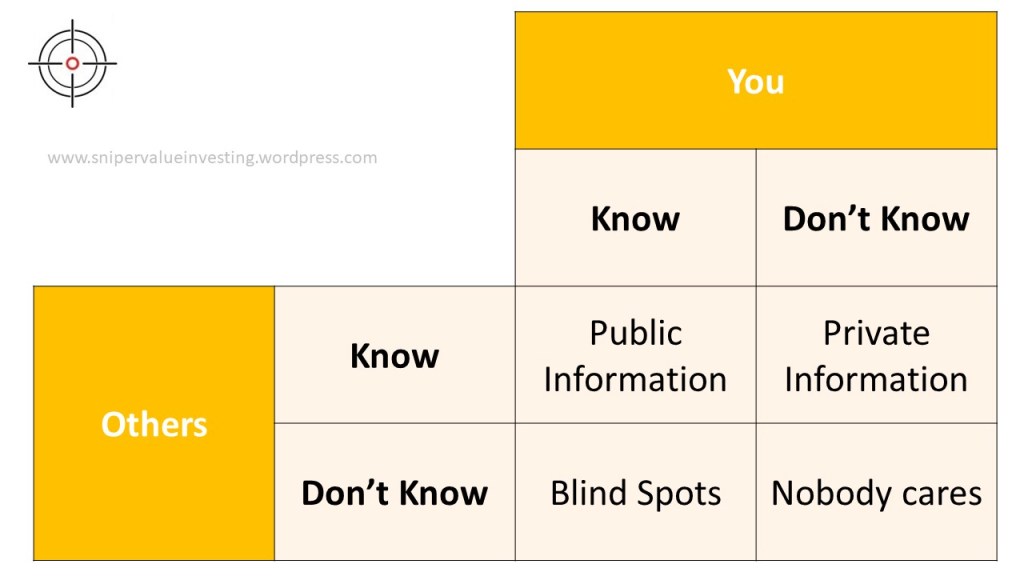
Being disciplined to stick to our Circle Of Competence, and it is important for us to know what we do and don’t know. I like to use the following diagram (modified from the Johari Window) to cover this:

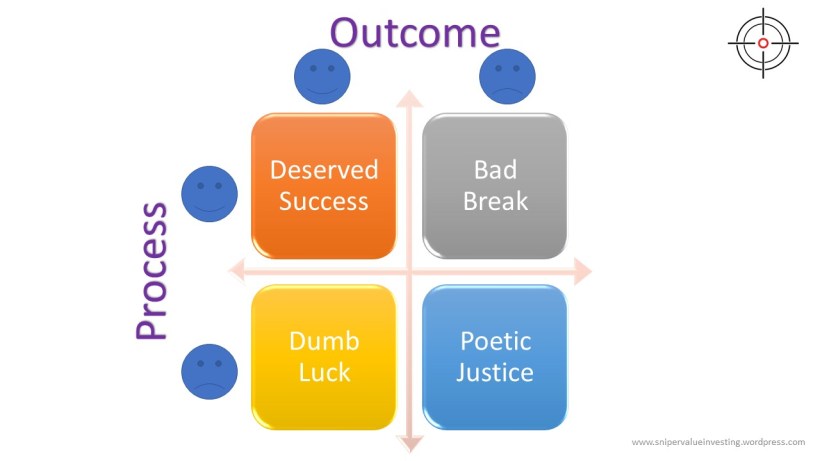
Sometimes, it is also about improving our processes over time to build a stronger and more resilient portfolio. In one of my previous posts, I mentioned the following matrix on Process v Outcome:

Now we will attempt to answer the following questions:

Why do you think it is not good to stay within your Circle Of Competence (COC)?

Sometimes, we tend to miss out on opportunities that we think we may be within our COC but actually are. This narrows down the number of companies that we could potentially select from. For example, if we don’t think companies in financial services is within our COC, we will more than likely exclude these companies from our selection, leading to a “biased” portfolio.

Why do you think it is good to stay within your COC?

If you understand a particular industry very well, you are more likely to have a rigorous process to evaluate whether a company is high quality or low quality and whether it is overvalued, fair valued or undervalued. This allows one to spot better opportunities within those sectors since different sectors will likely require different metrics. Would you trust a biotechnologist to evaluate whether a bank is in good shape? Probably not. Similarly, you probably won’t ask a banker to evaluate a biotechnology company if he/she doesn’t have any clue of how certain biological processes such as RNAi or antigen-antibody binding works.

Do you think, naturally, you are the type who will usually stay within your COC or not & why? What are you going to do or systemize to prevent potential future mistakes?

I tend to be someone who likes to explore different things (otherwise I won’t be an entrepreneur). Sometimes, it is important to watch myself when going into “unchartered territory” when it comes to value investing. It is about constantly reminding myself that there is a better opportunity another day. Like investing into the private markets, it is important to build my own due diligence checklist over time. We already have some of the quantitative models that we have built over time, and we will continue refining them as we go along.

How will you be influenced by fear and greed to make good or bad decisions in the stock market?

For me, I view investing in the markets just like investing into private companies. In fact, my brokerage account is a corporate brokerage account. In that manner, I think sometimes, it is more of watching what others are feeling in the market to know when a good time to enter is. Many a times, I have the tendency to “catch a falling knife”. I think that requires a lot of emotional stability to do. Again, it is about the psychological aspect of things that keeps me alive and well. Maybe that’s why being an entrepreneur is good because it takes away your attention from the market. Just leave it to ride as you have picked something high quality.

How can you use fear and greed for value investing and covered options selling purposes?

As mentioned, it is about putting companies of high quality into my watchlist and waiting for the falling knife to unlock the window of opportunity. Maybe it is time for me to start building some quant models to trigger price alerts as needed? Haha.

Jokes aside, fear and greed are emotions that create a schizophrenic market. Therefore, it is about leveraging on these emotions of people to make emotionally stable, sound and rational decisions when buying / selling securities. Sometimes, we just have to be cold and calculating when it comes with dealing on the market – who knows, AI might do a better job than us at that?

List the sectors or categories you think you understand and why? 

  • Healthcare/Biotech: I was a biotechnology/biomedical structural biology student in college. One of our key research areas was around RNAi and its effects on cancer. I had gotten a grant to work on bioremediation of plastics using genetic engineering back in my days in college.
  • Technology: As a VC and technopreneur, I have been building and heavily investing into technology companies of the future in the private markets. With that, we have built a portfolio of at least 20 direct investments into privately held technology companies while also building a few ourselves.

List at least three companies you understand (a summary about the company) within your circle of competence (Morningstar).

Company name: Pfizer, Inc.
Sector or industry: Healthcare/Biotech (Pharmaceuticals)
Summary of the company: Pfizer is one of the world’s largest pharmaceutical firms, with annual sales close to $50 billion (excluding COVID-19 product sales). While it historically sold many types of healthcare products and chemicals, now, prescription drugs and vaccines account for the majority of sales. Top sellers include pneumococcal vaccine Prevnar 13, cancer drug Ibrance, cardiovascular treatment Eliquis, and immunology drug Xeljanz. Pfizer sells these products globally, with international sales representing close to 50% of its total sales. Within international sales, emerging markets are a major contributor.

Company name: Crowdstrike Holdings Inc. (Class A)
Sector or industry: Technology (Cybersecurity SAAS)
Summary of the company: CrowdStrike is a cloud-based cybersecurity company specializing in next-generation endpoint and cloud workload protection. CrowdStrike’s primary offering is its Falcon platform that offers a proverbial single pane of glass for an enterprise to detect and respond to security threats attacking its IT infrastructure. The Texas-based firm was founded in 2011 and went public in 2019.

Company name: Regeneron Pharmaceuticals Inc.
Sector or industry: Healthcare/Biotech (Pharmaceuticals)
Summary of the company: Regeneron Pharmaceuticals discovers, develops, and commercializes products that fight eye disease, cardiovascular disease, cancer, and inflammation. The company has several marketed products, including Eylea, approved for wet age-related macular degeneration and other eye diseases; Praluent for LDL cholesterol lowering; Dupixent in immunology; Libtayo in oncology; and Kevzara in rheumatoid arthritis. Regeneron is also developing monoclonal and bispecific antibodies with Sanofi, other collaborators, and independently, and has earlier-stage partnerships that bring new technology to the pipeline, including RNAi (Alnylam) and CRISPR-based gene editing (Intellia).

Recent Thoughts on Value Investing (Part I)

Note: This is going to be a constant series as I embark on my journey in Value Investing Mentorship. If you want to find out more, please email me at team@lancequek.vc. The author does not take responsibility for any factual inaccuracies made. Any opinions, conclusions, or other information expressed here is not financial advice. They are given on a general basis and are subject to change without notice. Your personal investment decisions are ultimately based on your financial goals, investment time horizon, risk appetite, and portfolio needs – which we do not advise. All information, data, and analysis here are provided “AS IS” and without warranty of any kind, either expressed or implied. Past performance is no indication of future performance; you are recommended to verify all information and consult licensed, professional financial services. The author does not take any responsibility for any loss or damage of any kind made based on the opinions or facts published in this document.

A re-visit of value investing and its fundamental principles, with some interesting takeaways. The first session was more of a mindset lock in:

  1. Having the emotional stability – don’t sell when everyone is selling, understand what is going on first and filter as necessary
  2. Value investing: looking at mispriced stocks, aim for longer time horizon
  3. Usage of options to generate cash flow while waiting
  4. News will affect the price of the stocks – understand the value

I will share my own thoughts on these questions and how I feel one can look at this and apply principles as necessary.

What are the cons of value investing/business-like investing and options selling, and what can you foresee yourself doing wrong when you apply them based on your character (and how you can overcome them)? Think about what kind of character you have as a person and how it might affect your investment decision.

The likely cost of value investing and options selling would likely be the greed one may get into. A lot of times, we can be chasing short term gains such as the higher premiums, but it is always important to remind ourselves to keep a margin of safety. Are you truly willing to pay this price if there isn’t any option premiums involved? Also, many tend to over-leverage when playing with options, which can result in painful margin calls (just look at what happened to Archegos). Being an entrepreneur who has built businesses from ground zero through the power of scalability, I think I can be pretty aggressive at times. Probably a good business starter strategy, but will need to find a successor who is more “defensive”? I like to play offensive, which can be a good thing in business, but maybe I need to be a little… different (is that the right word?) when it comes to investing where I think about my own margin of safety.

What are the pros of value investing/business-like investing and options selling, and why or why not do you see your character being able to complement value investing and options selling methodology? What do you see yourself doing right and wrong when you apply them?

Business-like investing allows one to own a company as if it is a private market transaction. More importantly, we could sleep well at night, knowing that the business model and management is working for us to generate the necessary returns. While waiting, I could probably underwrite put options to generate some subsidies for the share price to increase my own margin of safety. I think as a private equity investor, we are used to holding assets for the long term. Imagine a day when the entire stock market collapses… We won’t be affected because nothing has changed fundamentally (unless you own shares of the stock market operator then that’s a different story). The key is for me to probably watch my cash flow while doing the options underwriting strategy to ensure we have enough capital to hold the shares indefinitely without having to enter margin territory.

Hopefully, this gives you a flavor of what is going through in my mind as I re-discover this skill…

Beneish M-Score: The “Fraudster” Metric

Looking back at the SPAC craze over time, we have seen a number of frauds going public. Some include Nikola Corp (Nasdaq: NKLA) and WeWork (NYSE: WE). There were also many companies that were eventually discovered as frauds, such as WireCard (FRA:WDI), CoAssets (ASX:CA8) and of course, the one and only Enron (NYSE: ENE). How do investors get an indication on the probability of getting into a scam?

In comes the Beneish M-Score. This is derived from a mathematical model that uses financial ratios and eight variables to identify whether a company has manipulated its earnings.

These variables are derived from the financial numbers that could easily be found in the company’s financial model. These variables are the Days Sales in Receivables Index (DSRI), Gross Margin Index (GMI), Asset Quality Index (AQI), Sales Growth Index (SGI), Depreciation Index (DEPI), Sales General and Administrative Expenses Index (SGAI), Leverage Index (LVGI) and Total Accruals to Total Assets (TATA).

See the formula sheet here.

If the score is less than -1.78, the likelihood of the company being a manipulator is low. However, if it is higher than -1.78, there is a higher probability that earnings could have been manipulated.

However, do note that the Beneish M-score is a probabilistic model. Therefore, it cannot detect companies that manipulate their earnings with 100% accuracy. Also, financial institutions such as banks and insurance companies were excluded from the sample in Beneish paper when calculating M-score. This means that the M-score for fraud detection cannot be applied among financial firms.

For those who are interested, you can find Beneish’s original 1999 paper here. Our team is has also created a new Beneish M-Score calculator for your own use. Catch you all soon!

Current Stocks I’m Looking at During COVID-19 [Part 1]

Many people have panicked during the stock markets being volatile when the COVID-19 crisis hit. However, I do see this as a very good opportunity to buy really good stocks with strong fundamentals. I will be sharing 1 of the stocks that I am looking at for this crisis.

ZScaler, Inc. (Nasdaq:ZS)

Zscaler is a global cloud-based information security company that provides Internet security, web security, firewalls, sandboxing, SSL inspection, antivirus, vulnerability management and granular control of user activity in cloud computing, mobile and Internet of things environments.

The company was founded in 2008 by Jay Chaudhry, a serial security entrepreneur who previously founded and later sold AirDefense, CipherTrust, CoreHarbor and SecureIT, and Kailash, the former chief architect of NetScaler. The company is unique among the private technology company “unicorns” in being significantly self-funded by the founder himself, is cash-flow neutral, and is on a very fast track of growth year over year. In 2012, Zscaler raised $5 million in venture capital from Lightspeed Venture Partners plus received a strategic investment from EMC Corporation as part of a $38 million expansion round. Zscaler has a reported company valuation of “well north of $1 billion.” On August 3, 2015, Zscaler announced a $100 million pre-IPO fundraising led by TPG Capital Growth. On September 23, 2015, Zscaler announced that the $100 MM round had been oversubscribed and has been raised to $110 million including a $25 million investment from Google Capital.

ZScaler has products in the cybersecurity scene including Zscaler Internet Access, Zscaler Next Generation Firewall and Zscaler Cloud Application Security. These products are well-poised for the growth of the Internet of Things (IoT) era and would likely be one of the key solution for companies that need to digitize. We have seen a big scandal about Zoom’s security (which isn’t their problem because the users have not made sure their devices have the necessary cybersecurity protection). Zscaler is poised to leverage on this to grow its market share.

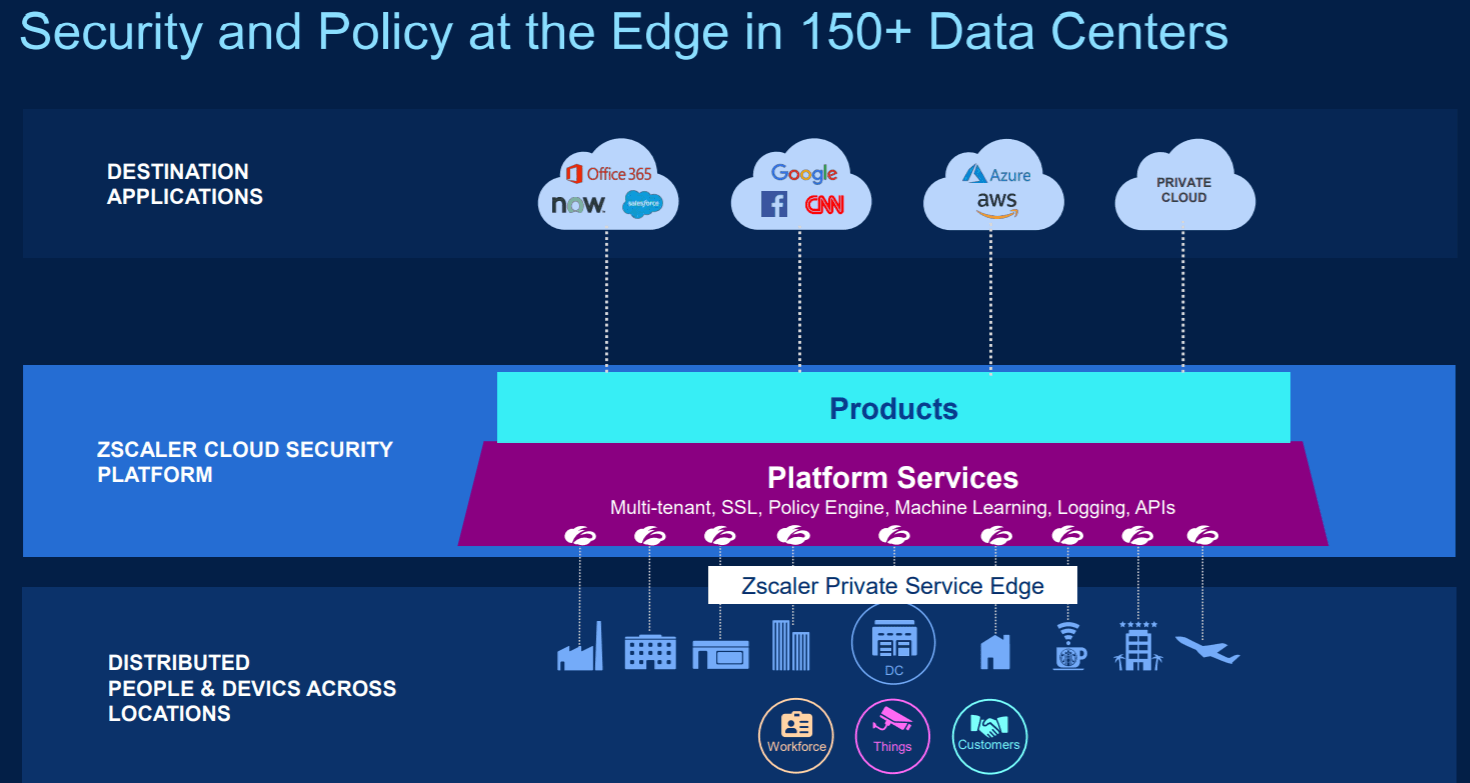
The best part of Zscaler’s offering is that it is able to integrate across different platforms which the clients are using.

Destination Applications that could be integrated with Zscaler

Looking at their financials, we do see high growth in annual recurring revenues and a path to profitability. They have been in net cash position and are already generating positive free cash flows.

Zscaler Financials from 2017 to TTM (as at this article) – From MorningStar

In short, I do see Zscaler having the ability to scale fast given their revenue growth of 55+%. Looking forward to sharing more in future.

If you would like me to do a webinar on Zscaler, please comment “YES TO WEBINAR” in the comments section below.

Peace.

Disclaimer: This is not a recommendation to buy/sell any securities. Please do your own due diligence.

24 Lessons from Berkshire Hathaway’s 2018 Letter to Shareholders

A couple of months back, Warren Buffett published a letter to his shareholders (as he always does), and some of the key lessons are highlighted very nicely by Vishal Khandelwal (Safal Niveshak) in his post.

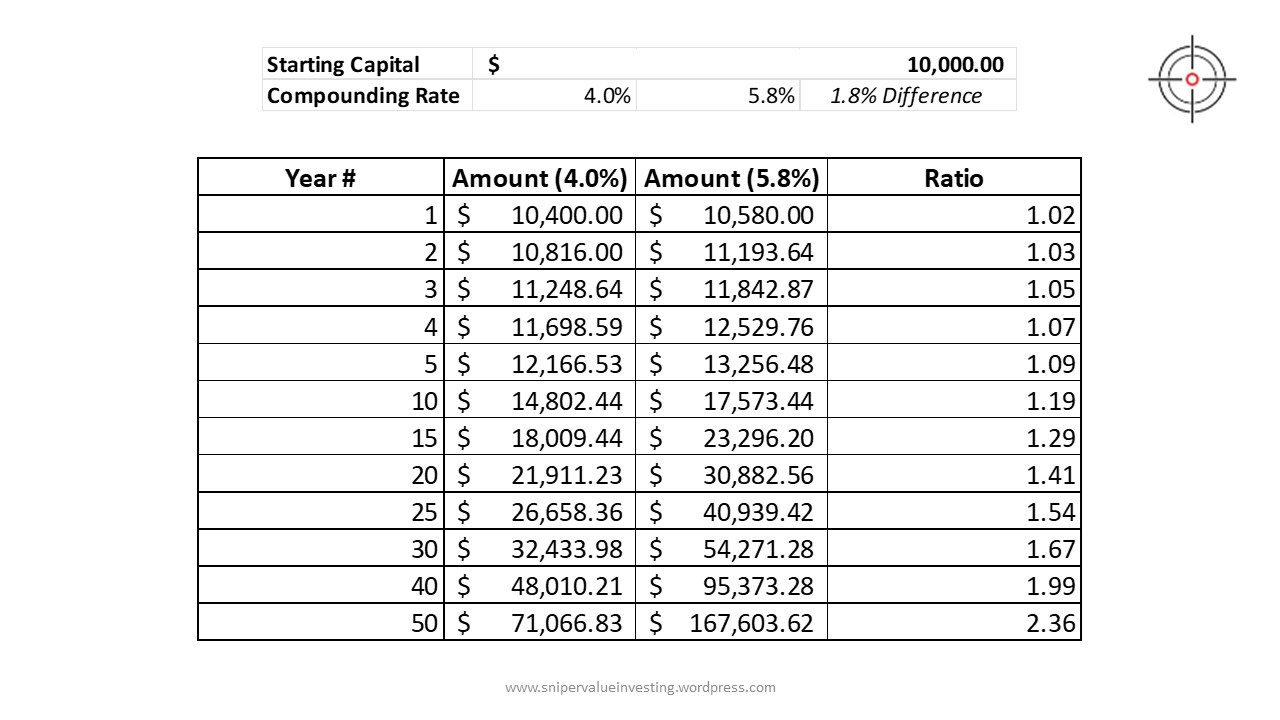
  1. The power of compounding. If I have a CAGR that is 1.8% higher than someone else, in 50 years’ time, my total return on my invested capital would be about 2.36x of his. You can look at this small calculation I did.SVI - Cmpdg1
  1. Following up from #1, I just need 2 things: the conviction to hold when the stock is down, and time. Time to go prepare for a healthy and happy life, while looking for awesome companies to buy and hold.
  2. Book value is a cheat-sheet substitute for the intrinsic value of any company. Over the long term, the market will track the intrinsic value. Book value may diverge from the market value for in the short term but will converge over the long term. What this means is that we need to have the conviction to hold (or even buy more) when the markets enter a downturn.
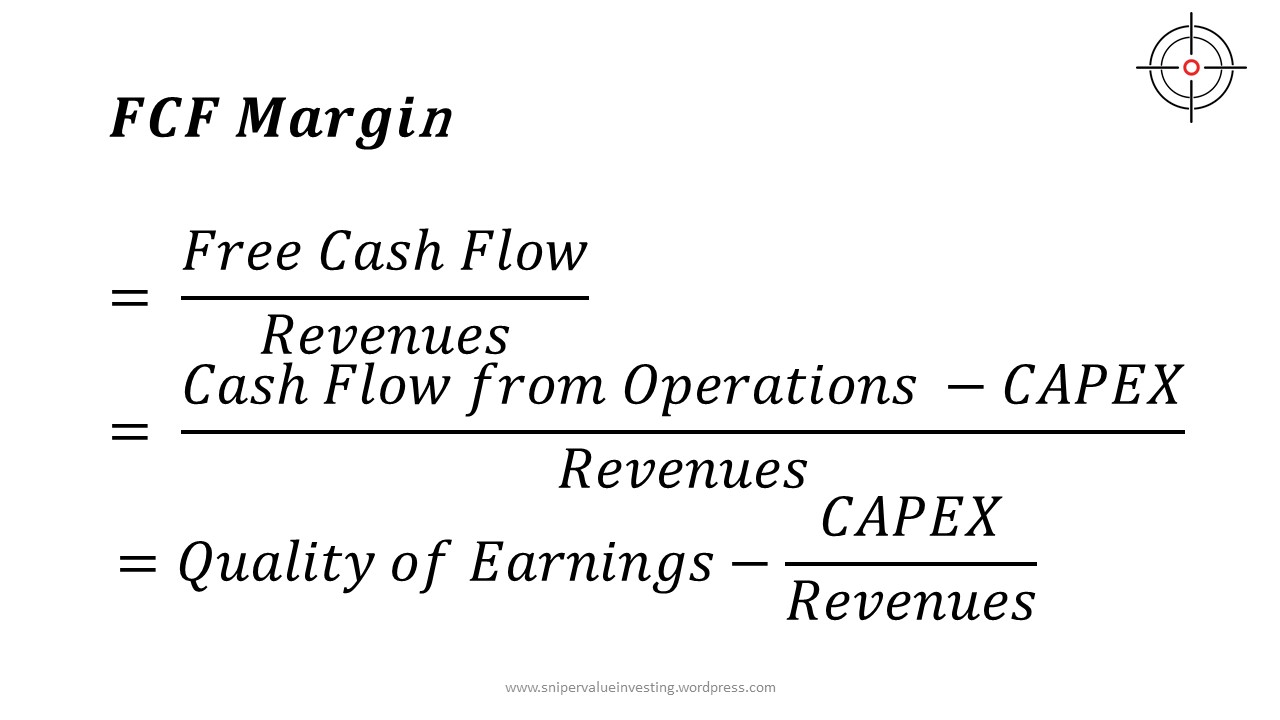
  3. Focus on operating earnings, paying little attention to gains or losses of any variety. Operating earnings (EBIT) tells us the true profitability of the business. Sometimes, the net profit can be distorted by external factors out of the company’s control. As such, EBIT are more suitable when we look at companies. This is also the reason why I prefer FCF over NPAT. I would like to define a term that I will be using quite often in this post, the cash profitability margin (also called Free Cash Flow, or FCF, Margin) as:
  4. The math of share buyback: Each transaction makes per-share intrinsic value go up, while per-share book value goes down. That combination causes the book-value scorecard to become increasingly out of touch with economic reality. Sometimes, management tries to execute share buybacks (at all costs even) to artificially create demand for the stock price. However, this works against the long-term benefit for the shareholders.
  5. Buy ably-managed companies (stocks), in whole or part, that possess favorable and durable economic characteristics. We also need to make these purchases at sensible prices. Essentially, look at companies that can offer excellent value, far exceeding that available in takeover transactions.Slide3
  6. Let us see investing using a wide-angle lens, taking a long horizon with the objective of striving for long, sustained upwards capital appreciation rather than the short-term volatility which traders tend to focus on. Many investors fail because they fail to control their own emotions.
  7. A lot of times, the brand of earnings is a far cry from that frequently touted by Wall Street bankers and corporate CEOs. Too often, their presentations feature “adjusted EBITDA,” a measure that redefines “earnings” to exclude a variety of all-too-real costs. It is much better to understand the Free Cash Flow or Owners’ Earnings (as per the Shareholder’s Letter of 1986) to make a clearer judgment on the company.
  8. Managements sometimes assert that their company’s stock-based compensation shouldn’t be counted as an expense. And restructuring expenses? Well, maybe last year’s exact rearrangement won’t recur. However, the cost is always borne by the shareholders, not a very good sign for us unless they are really performing very well…
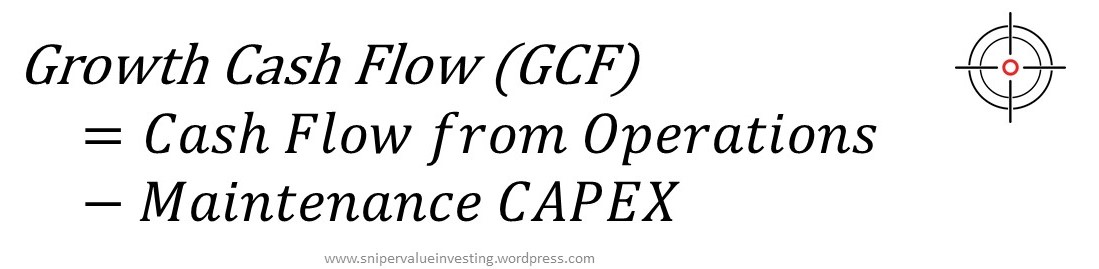
  9. Back to point #8, capital expenditures (CAPEX) can be split into two types: growth and maintenance CAPEX. Growth CAPEX is the CAPEX that is incurred for the company to scale and expand, while maintenance CAPEX is the CAPEX incurred to maintain the company’s operations in good shape. A good indication of maintenance CAPEX is the depreciation and amortization (which is why EBITDA isn’t a very good indicator contrary to what most institutional investors believe). It is important for us to differentiate between maintenance CAPEX and growth CAPEX to discuss the quality of the company. As such, I would like to introduce another term: Growth Cash Flow (GCF):
  10. Some people keep saying it is best for the company to declare dividends to be aligned with the shareholders. Far more important than the dividends, though, are the huge earnings that are annually retained by these companies. For companies that can earn high returns on incremental retained earnings, shareholders are better off not receiving the dividends and letting the company tap into its stronger growth potential and hence capital appreciation. These companies enjoy excellent economics, and most use a portion of their retained earnings to repurchase their shares. When earnings increase and shares outstanding decrease, owners – over time – usually do well.
  11. There should always be a margin of safety when we invest (which is why I always say never use margin accounts to trade, and never invest what you need to survive). By doing proper portfolio management (which I will have a podcast about), we need to set aside some cash (12 months of expenses minimum) and consider that stash to be untouchable to guard against external calamities. Avoid any activities that could threaten our maintaining that buffer. Never risk getting caught short of cash.
  12. In the current market, prices are sky-high for businesses possessing decent long-term prospects. In this case, it is better for us to wait than to jump into the hype that the market has created, also known as FOMO. Predictions of that sort have never been a part of our activities (and I hope it isn’t in yours too). Our thinking, rather, is focused on calculating whether a portion of an attractive business is worth more than its market price. Let us not try to predict the future but create it by making sound investment and business decisions.
  13. Truly good businesses are exceptionally hard to find. Selling any you are lucky enough to own makes no sense at all. Remember, never sell a high-quality business (or at maximum, sell as little as possible to recoup your capital and let the rest roll). Let the business work for you by compounding your investment returns.
  14. Blindly buying an overpriced stock is value destructive, a fact lost on many promotional or ever-optimistic CEOs. This is a very important lesson for CEOs and management teams (always be honest in your communication to your shareholders). Trust is the most important asset any management team can have. When a company says that it contemplates repurchases, it’s vital that all shareholder-partners be given the information they need to make an intelligent estimate of value.
  15. Many a times, you would see analyst estimates for quarterly earnings per share results. Never be focused on that. Quarter on quarter is simply too short-sighted for value investors like us. Let us focus on the forest rather than the individual trees. Playing with the numbers “just this once” may well be the CEO’s intent; it’s seldom the result at the end of the day. And if it’s okay for the boss to cheat a little, it’s easy for subordinates to rationalize similar behaviour. This can be seen in many cases, including Enron and Hyflux. Remember, what started off as a marginal gap between the actual operating profit and the one reflected in the books will continue to snowball and reach a point of unimaginable proportions, resulting in a whole mess. This has been compared to (by Ramalinga Raju) riding a hungry tiger without knowing how to get off without being eaten.
  16. The property/casualty insurance business creates a large sum in cash float, due to its collect-now, pay-later model. This float will eventually go to others. Meanwhile, insurers get to invest this float for their own benefit. Though individual policies and claims come and go, the amount of float an insurer holds usually remains stable in relation to premium volume. Consequently, as such businesses grow, so does the float of the company. This is one of the key success factors of Berkshire Hathaway. This is one of the key metrics in analyzing any insurance company. The competitive dynamics almost guarantee that the insurance industry, despite the float income all its companies enjoy, will continue its dismal record of earning subnormal returns on tangible net worth as compared to other American businesses.
  17. In most cases, the funding of a business comes from two sources – debt and equity. At rare and unpredictable intervals, however, credit vanishes, and debt becomes financially fatal. A Russian roulette equation – usually win, occasionally die – may make financial sense for someone who gets a piece of a company’s upside but does not share in its downside (Remember: Risk = Probability of the harm occurring x Severity of the harm). But that strategy would be madness for Berkshire. Rational people don’t risk what they have and need for what they don’t have and don’t need. Debt should only be used strategically and sparingly.
  18. By retaining all earnings for a very long time, we allow compound interest to work its magic. This brings us back to point #1 on the power of compounding. Beyond using debt and equity,
  19. Berkshire has benefitted in a major way from two less-common sources of corporate funding. The larger is the float I have described. So far, those funds, though they are recorded as a huge net liability on our balance sheet, have been of more utility to us than an equivalent amount of equity. That’s because they have usually been accompanied by underwriting earnings. In effect, we have been paid in most years for holding and using other people’s money. The final funding source – which again Berkshire possesses to an unusual degree – is deferred income taxes. These are liabilities that we will eventually pay but that are meanwhile interest-free. This gives Berkshire the ability to make money while waiting for these two sources of funds to reach a point where they must pay them out.
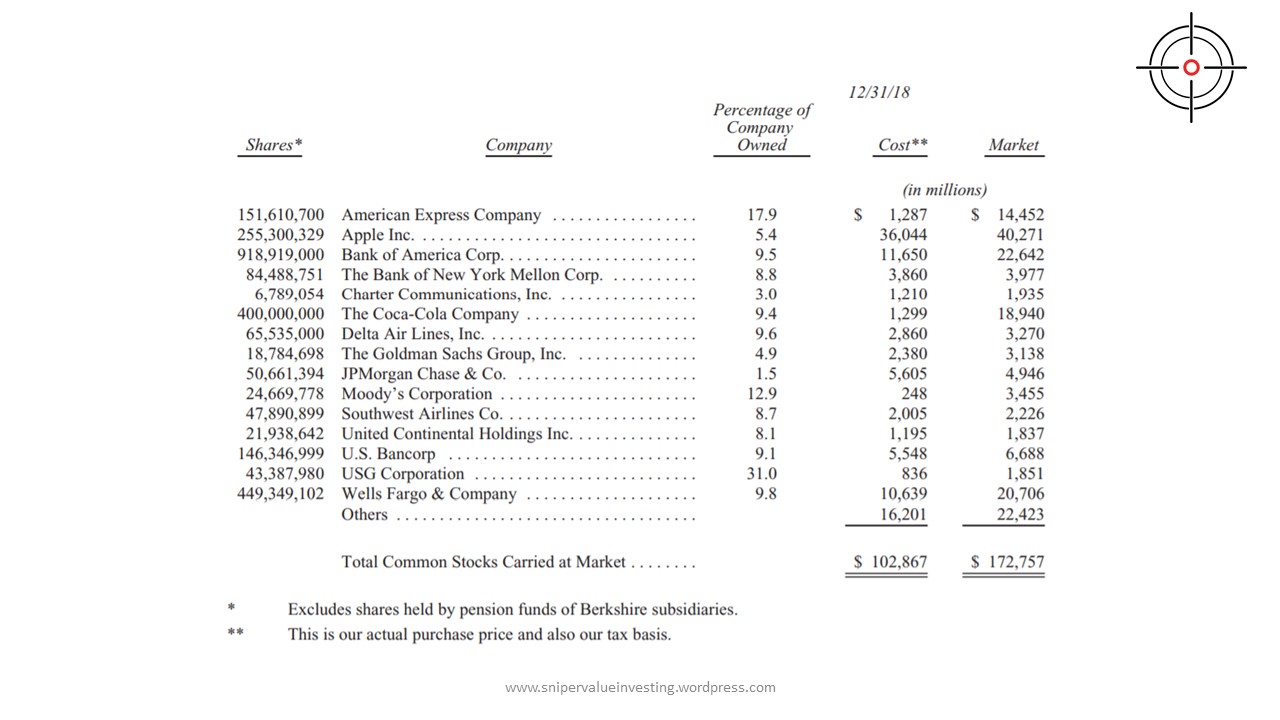
  20. Do not view your portfolio as a collection of ticker symbols – a financial dalliance to be terminated because of downgrades by “the Street,” expected Federal Reserve actions, possible political developments, forecasts by economists or whatever else might be the subject du jour. View them, instead, as an assembly of companies that you partly own. You may also want to ensure your portfolio companies, on a weighted average basis, are earning about 20% on the net tangible equity capital required to run their businesses and earn their profits without employing excessive levels of debt. Remember, shares are not mere pieces of paper. They represent a partial ownership of a business. When contemplating any investment, think like an entrepreneur or a business owner. Taking a look at Berkshire Hathaway’s holdings:
  21. On occasion, a ridiculously-high purchase price for a given stock will cause a splendid business to become a poor investment – if not permanently, at least for a painfully long period. Over time, however, investment performance converges with business performance. And, as I will next spell out, the record of American business has been extraordinary. A great business may not necessarily be a great investment when you overpay (buy at overvalued prices). However, in the long-term, business performance holds a much greater relevance than the original price paid. This would take many investors a long time to understand.
  22. Make time your friend. Start investing in the right way early to compound more. Also, just like investments, fees paid to investment managers and consultants also compound. A $1 million investment by a tax-free institution of that time – say, a pension fund or college endowment – would have grown to about $5.3 billion after 77 years. However, if the institution had paid only 1% of assets annually to various “helpers,” such as investment managers and consultants, its gain would have been cut in half, to $2.65 billion.
  23. In the short-term, you might panic because of stock market crisis or some government action. To “protect” yourself, you might have ditched stocks and opted instead to buy gold (let’s say 3.25 ounces for $115). After 77 years (based on past records), this would have been worth about $4,200, much less than what you would have if it was in businesses. In the long-term, stocks/businesses, if invested with the right framework, will always outperform gold.

It is time for us to reflect on our investing journey so far to make some corrections (if necessary) to our mindset…

The CAGR Variance Dilemma

Recently, Rupam, a good friend of ours, shared something interesting in a WhatsApp group we are part of. It was a simple question.

You have been given $10,000 to invest and you must choose only one of the two options (A or B mentioned below. Which option will you choose? Assume both options are safe.

Option A portfolio :
Invest $2,000 each in 5 different investments…where each of them give you an annual return of exactly 10%…so your overall annual return is exactly 10%

Option B portfolio :
Invest $2,000 in 5 different investments where the individual annual returns are all different for each 5 component investment …some are negative…some are positive…but the arithmetic average of all these 5 return figures is 10%…(please note this 10% is NOT the overall return of the portfolio but just the arithmetic average of the individual return %s….so the overall annual return of the portfolio is different)
Example:
Investment 1: (16%)
Investment 2 : (- 6%)
Investment 3: (0%)
Investment 4 : (60%)
Investment 5: (-20%)
The arithmetic average of 16, -6, 0, 60 and -20 is (16-6+0+60-20)/5 = 10
Which option will you chose?
P.S.: Kindly do not worry about whether this is a real life scenario or not….the question can be answered with the information provided

Based on the statistics he provided, there were a total of 426 responses, with 59% of people choosing Option B, and 41% of people choosing Option A. Interestingly, some respondents have changed their responses after some discussions. Based on pure mathematics, Option B seems like the better choice.

However, while the potential return of Option B seems better at first glance, one has to account for the variance involved in the portfolio (remember that Option A’s variance is 0). For example…if the individual returns of the investments in portfolio B were 8%, 9%, 10%, 11%, 12% (still keeping the arithmetic average = 10%) then the value of Portfolio B would become ~ $26,131 in 10 years (which is > $25,937 for Portfolio A)….however if the variability increases significantly…as in the example (16%,-6%, 0%, 60%, -20%), the value after 10 years for Portfolio B becomes $232,017. In the above scenario, Portfolio A is always going to be the worst possible performing portfolio.

Some A respondents even justified their choice saying ‘they want to sleep well’…all they had to do is a simple calculation to realise that in reality their sleep would be sounder if they chose B…because most of the time B would perform better. I am probably not smart enough to explain this human bias but it could very well be people’s preference to think ‘linear’ instead of ‘exponential’ (and ignore 2nd order outcomes…longer term compounding being one of them).

However, there was another viewpoint that it may not just be a false sense of security. A calculation could be used in this example may exemplify that.

Portfolio A provides a total return of about 260% (260% TVPI), while Portfolio B only provides about 210% TVPI. So it might not be so bad after all… Credits to Beng

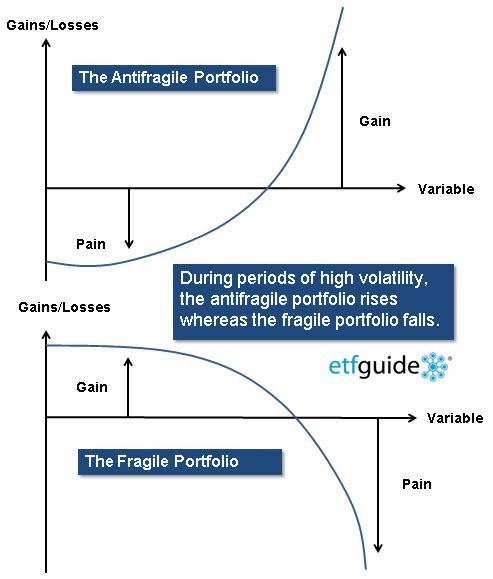
After that, a WhatsApp message in the group by Herbert (another good friend of ours), talked a little about variability. And it says “Just an add on, having variability is not always good compare to certainty as suggested. In fact, Nassim Taleb did point this out too. There is a key part you need as well which is the antifragile aspect otherwise variation could lead to huge loss.”

So, what is your choice? Feel free to share with us in the comments below.

Reference: http://moneywisesmart.com/portfolio-a-vs-portfolio-b-the-findings/

Case Study: Teva Pharmaceuticals Industries

Recently, Berkshire Hathaway (NYSE:BRK/A, NYSE:BRK/B) has increased their stake in a pharmaceutical company known as Teva Pharmaceuticals Industries (NYSE:TEVA, TASE:TEVA).Teva Pharmaceutical Industries specializes primarily in generic drugs, but other business interests include active pharmaceutical ingredients and, to a lesser extent, proprietary pharmaceuticals. Incorporated in 1901 and listed on the New York Stock Exchange in 2012, it is the largest generic drug manufacturer in the world and one of the 15 largest pharmaceutical companies worldwide. However, due to huge losses in 2016, the numbers don’t look very well.

The PowerPoint presentation attached here shows my personal take on the company.

Before making any decision, please do your own due diligence!

Feel free to share with me your thoughts about Teva in the comments section below! 🙂

How Schizophrenic is Mr. Market?

I remember that as a kid, I wanted to go to medical school (and that is still true today). Today, I have a patient by the name of Mr. Market. He is more than 70 years old, and was brought in by Mr. Investor as he has suspected signs of schizophrenia. I shall now go through with you what I realized about Mr. Market.

Recently, there was some panic in the Malaysian stock market, with a lot of uncertainties going on there. Many investors are having a hard time stabilizing their emotions and are in a rush to either get in or get out of the stock. Share prices have fluctuated like mad (which is one of the signs for the diagnosis) and many investors got panicky (which was why Mr. Investor brought Mr. Market to me for the clinic appointment).

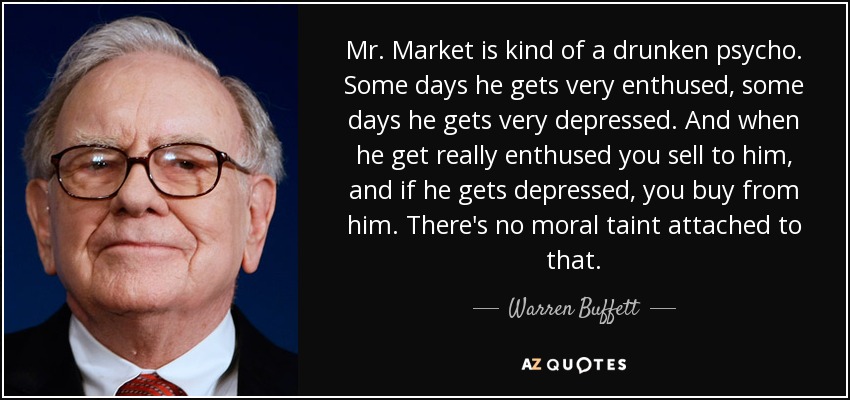
Not being a specialist in market psychology and psychiatry, I decided to write a letter of referral for Mr. Market to one of the best doctors in this field. Let’s look at what Uncle Warren has to say about this:

quote-mr-market-is-kind-of-a-drunken-psycho-some-days-he-gets-very-enthused-some-days-he-gets-warren-buffett-113-85-82

warren-buffett-quotes-02

Like Uncle Warren, I would prefer to go for a “buy-and-hold” approach compared to a “buy-and-sell” approach. If I pay slightly higher prices today for an awesome company due to their high quality, I’m better off than paying a low price for a mediocre company. This is for a simple reason that the growth of the company will eventually make today’s price look undervalued. Let me make a hypothetical scenario out of this:

Screen Shot 2018-06-02 at 9.32.33 am

So as we can see, the “price” I pay per dollar of earnings is $4.83 for Company A and $1.10 for Company B. However, because I know that Company A has a much stronger quality compared to Company B (as seen from the ROE), I will say that Company A is more undervalued compared to Company B. As such, I will go for Company A even though I have to pay a higher price.

Beautiful theory, but how do I put it into practice? The approach goes like this:

  1. Set a limit to the number of companies you are going to invest in. Uncle Warren has a “20 ticket punch card” approach, where once he invests in a company, he will “punch” a hole in the card. He will not invest once all the punch card is full.
  2. Start analyzing businesses using the various metrics you have for such companies. Do note that different companies and industries require different valuation methodology, so do apply the correct one to the correct companies (e.g. don’t value a e-commerce company using price-to-book ratio because that simply doesn’t make sense). Also, it is key to ensure that your metric is justifiable (don’t use the metric simply because you make it look undervalued just to convince yourself to buy the stock – that is a big symptom of self-denial).
  3. When the share price comes down to a point it is within your valuation, you can start accumulating. Or if you like, you can be like me in the US market where I sell put options to start the process of accumulation (but have the mindset that it is already exercised once the order is filled) at an even better price. Always remember, market timing is completely irrelevant here.
  4. Keep looking for quality companies and repeat step 2, even after your punch card is filled. When we encounter a company that has a better quality compared to the company that is of the worst quality in our portfolio, replace the one originally in your portfolio to this new company. I usually use a sell call option on the former and a sell put option on the latter to do so. This way, we keep improving the quality of our portfolio as we select them. I like to rank my portfolio from 1 to 8 (my punch card has a total of 12 slots).

In electronics, we always talk about something known as the signal-to-noise (S/N) ratio. Before I used this approach, I realized that there is so much chatter in the coffee shops about some stocks and that literally creates more noise. By using this methodology, we increase the S/N ratio for our portfolio as we distill out the best companies we have found so far. All we need to do is to compare the worst guys in our portfolio to the potential candidate trying to come on board. It’s now a single combat, much easier to judge compared to the Warring States.

As our portfolio quality gets better over time, we will also be improving the process as we learn to be stricter in our selection. Remember, you are the buyer not the seller. You have the right of choice of the companies (and partners) you bring on board. This allows us to cut down on unnecessary trades, or selling when the price seems high. As Mr. Hemant Amin said, “the only cost in investment is opportunity cost.” Indeed, it is the case in both the public market and the private equity sector (which I deal with from time to time). If the whole objective behind selling a good quality company is to bag cash, then there is simply no point of taking action.

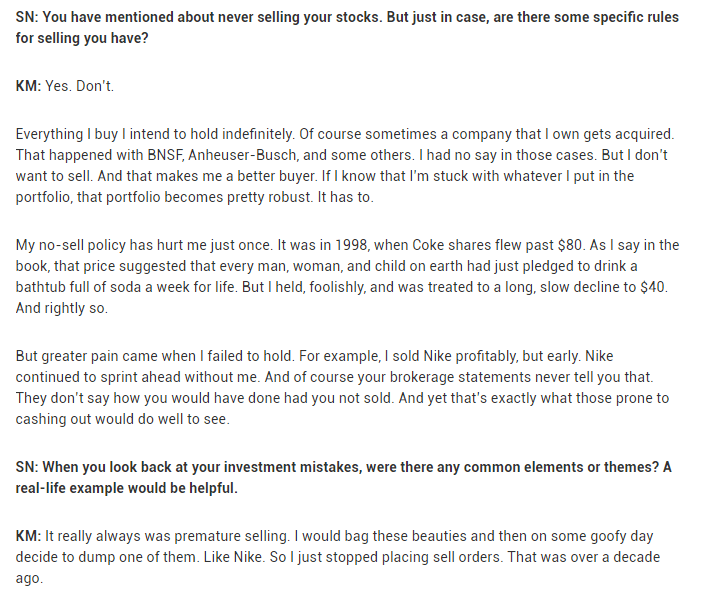
Let’s take a look at some insights from Kenneth J. Marshall (KM) when he accepted an interview with Safal Niveshak (SN), one of the top financial blogs I have read of all time:

dont-sell-e1527878496807

Hope this helps you in your process of distilling out the crème de la crème when you invest. Ciao! 🙂

I hereby diagnose Mr. Market with severe schizophrenia.

This blog post is done based on a reflection of my friend, Xin Er from Learnvestor.

Owner’s Earnings – A Much Better Indication for Cash Flow

Sometimes, we see free cash flow (FCF) as the key metric when we analyze some companies. Recently, I learnt about a new metric known as owner’s earnings (OE) from Xin Er and Rupam, which I find pretty interesting. This post will be talking that.

What I received from them was in fact a 20-page document detailing everything about how OE is calculated and used in the valuation of the company, specifically stating about its advantages and drawbacks compared to FCF. This surfaced to me because of a recent stock I was looking at, Biostar Pharmaceuticals Inc. (NASDAQ:BSPM), which had shown an increase in cash and cash equivalents despite making a loss in the same year. Let’s take a look at their 2017 income and cash flow statements:

Screen Shot 2018-05-27 at 8.56.24 pmScreen Shot 2018-05-27 at 9.13.49 pm

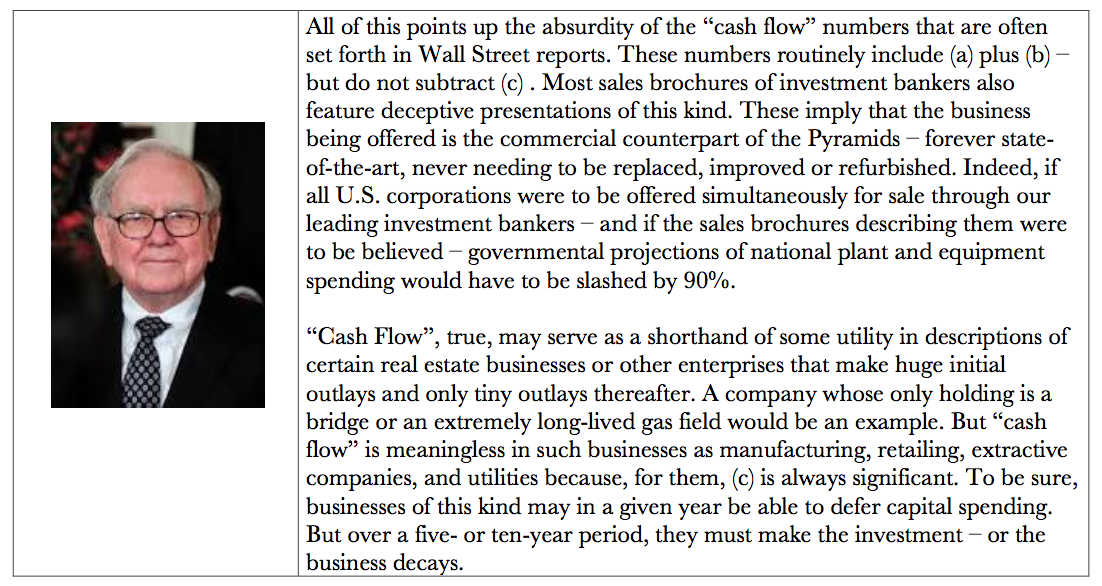
OE is a term coined by Warren Buffett in 1986 when he wrote his letter to shareholders of Berkshire Hathaway Inc. (NYSE:BRK/A) (NYSE:BRK/B). It is defined as a representation of (a) reported profits plus (b) any form of non-cash charges due to depreciation, depletion, amortization, and certain other non-cash charges such as the company’s items less (c) the average annual amount of capitalized expenditures for plant and equipment, etc. that the business requires to fully maintain its long-term competitive position and its unit volume. (If the business requires additional working capital to maintain its competitive position and unit volume, the increment also should be included in (c) . However, businesses following the LIFO inventory method usually do not require additional working capital if unit volume does not change.)

Here’s what Warren Buffett said about FCF:
Screen Shot 2018-05-28 at 1.53.19 pm

This definition sounds like a mouthful, so let me try to break it down for you. Most of the time, this would be very close to FCF, which is simple the cash flow from operations less capital expenditure. However, under certain circumstances, OE can differ quite a bit from FCF. Let us try to derive the OE of My Startup Company Pte Ltd based on the simulation below:

My Startup Company Pte Ltd (MSC) is a startup that focuses on the sales of energy across to households in Singapore due to the opening up of the energy market by the Energy Market Authority of Singapore. The company was incorporated on January 1, 2015, with financial year ending on December 31 of every year.

To simplify his accounting, the entrepreneur – Alan – decides to bear the cost of incorporation (allowing MSC to start off on a clean slate). His company lawyer that did the incorporation created 100,000 shares (with a value of $1 per share) and gave Alan 10,000 shares (for some reason he agreed to those terms). Alan decides to invest $110,000. This gives MSC a cash injection of $110,000 even before the company even started operations (income and expenses are still zero). Here’s how MSC’s balance sheet will look like:
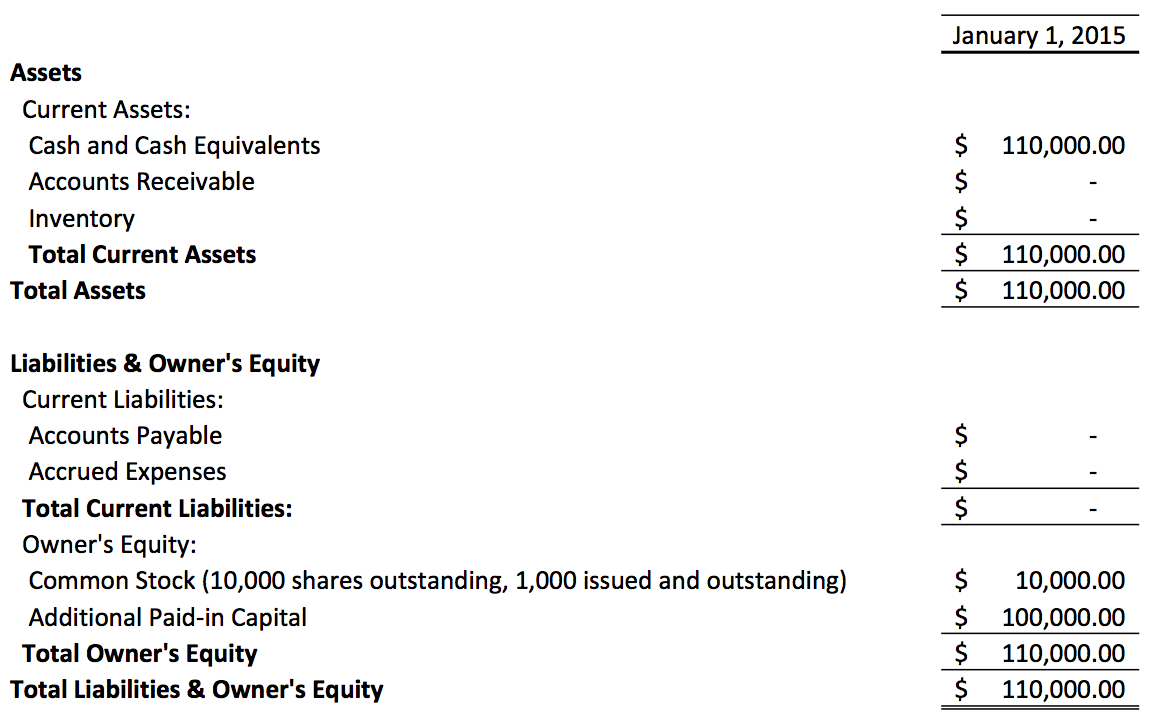
Screen Shot 2018-05-28 at 12.23.22 am

This balance sheet is probably pretty straight forward. Alan pumps in a total of $110,000 of his own money into the business’ checking account. $10,000 of this money is converted into his shares, which the other $100,000 is considered as additional paid-in capital. This money is given to the company as its cash and cash equivalents (CCE). Note that the additional paid in capital is what Alan invested above and beyond the par value of the stock!

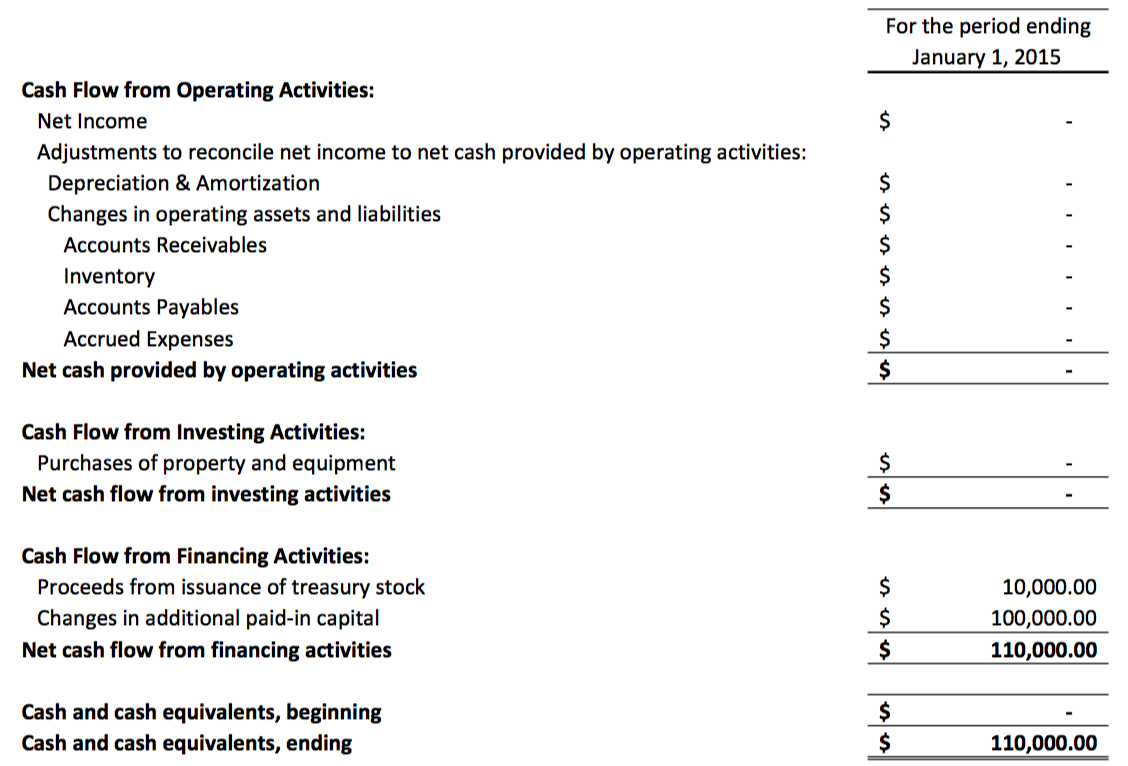
Sometimes, investors don’t want to just look at your balance sheet. Today, Bala, a potential angel investor decide to ask Alan for his cash flow statement as he is planning to invest in the company. Here’s what Alan sent to Bala (after asking Bala to sign an NDA):
Screen Shot 2018-05-28 at 12.30.18 am

As seen on this cash flow statement, there is no sale and profit generated at this point. There are no changes in inventories, accounts payables/receivables and accrued expenses. Hence, there is no cash flow from “operating activities” as there are no business activities to speak of at this point. There was no property and equipment purchased, so there is no cash flow from “investing activities”. However, the balance sheet showed an increase in CCE of $110,000 due to Alan’s investment. Therefore, there is a cash inflow from financing activities of $110,000. Of course, Bala would say “your idea looks great, but you need to get some sales to confirm that it works. For those reasons, I’m out!”

To fulfil Bala’s order for electricity for his office, Alan has bought a generator that costs him $50,000 (it’s pretty huge), as well as an additional $950 on some marketing materials to attract new customers. On top of that, he pays $50 to the telco for a business phone so that he can be contactable for business. Now, MSC is ready for business! Yay!

As Bala gave Alan a piece of advice before he left about lean startup, Alan decides to heed the advice and operate it out of a space in his dad’s plant (which is seriously huge by the way). Ready to make his first bucket of gold from here, Alan decides to hire a commission-only sales rep to go around and get business (PDPA doesn’t exist in this parallel universe). He estimates that his cost of manufacturing for Bala’s deal will be $5,000 per MWh. Suppose he sells to Bala at $10,000 per MWh and give the sales rep a 25% commission ($2,500), he will turn an operating margin of 25%.

On February 15, 2015, the sales rep approaches Bala (since there was already a relationship between him and Alan) and brings in an order from him for 5MWh for Bala’s factory just nearby. Alan records the sale in his books and runs the generator to produce the 5MWh of electricity for Bala. It takes 6 weeks to generate the energy and Bala has 30 days to pay up upon the completion of the power delivery. Of course, being a shrewd businessman, Bala would delay payment till end of April 2015 to make the payment so that he has a good cash conversion cycle on his listed company that manages the factory. Let’s take a look at MSC’s finances at the end of March 31, 2015.

Screen Shot 2018-05-28 at 9.29.29 am

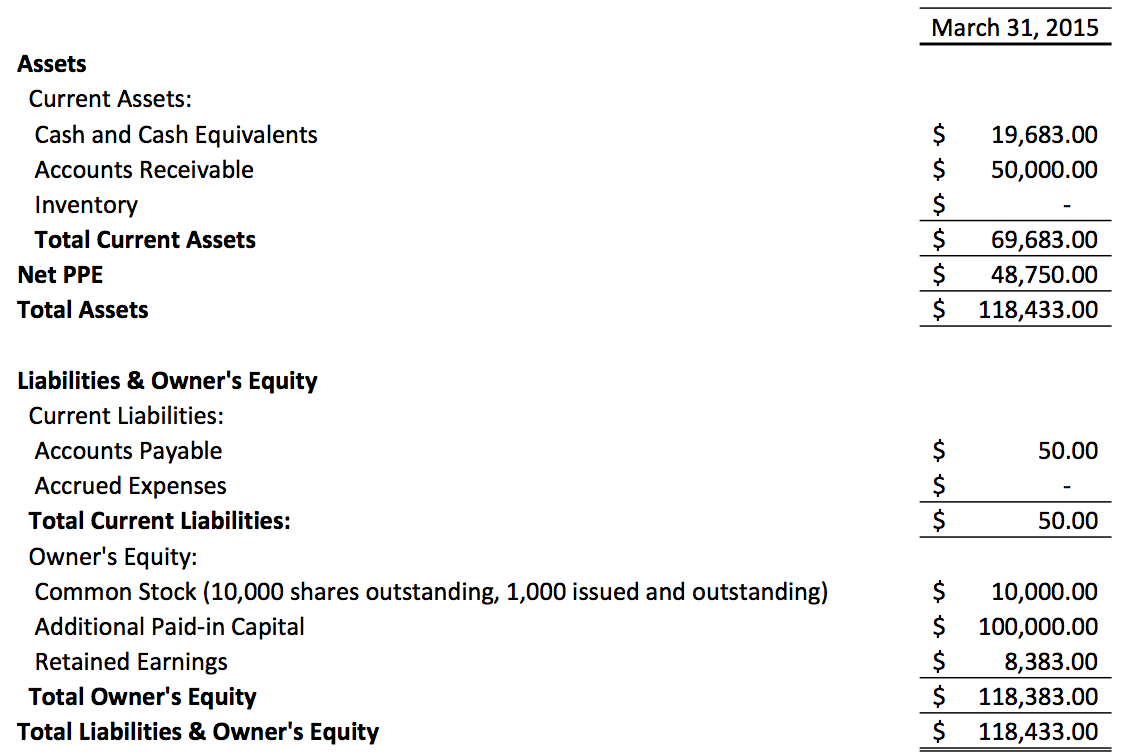
Now, let’s check out his balance sheet.
Screen Shot 2018-05-28 at 11.29.09 am

Things look quite alright at this point. Owner’s equity is up by $8,383 due to the net income that we saw in the income statement. We see an increase in accounts receivable of $50,000 due to Bala’s order, and a reduction in CCE to $19,683 due to the expenses in the income statement. However, as the generator has a depreciation of $5,000 every year, or $1,250 every quarter, we deduct the depreciation from our net property, plant and equipment (Net PPE).

As usual, phone bills are only payable 10 days after receipt of the bill. So Alan decides to learn that same trick from Bala and delay its payment until the very last minute. As such, there is an accounts payable of $50 to account for the phone bill that is unpaid. MSC has not racked up any accrued expenses (an accounting expense recognized in the books before it is paid for) thus far.

Which is pretty much about now…

Screen Shot 2018-05-28 at 11.28.21 am.png


For the sake of illustration, let us work bottom up. Just before Alan invests the $110,000, MSC has no money in the bank, therefore leading to a CCE beginning with 0. We also know that the company has a total of $46,400 in the bank after this quarter (from the balance sheet), accounting for the $46,400 in CCE ending. So what exactly happens in between.

Moving into cash flow from financing activities, we conclude that Alan has invested the $110,000 at the start of the year. This is consistent with the cash flow statement when the company first started.

Moving up is the cash flow from investing activities, we can see that Alan purchased the generator to produce the electricity for his clients. The generator requires a cash payment of $50,000, leading to a cash outflow from investing activities of $50,000.

Moving up into the cash flow from operating activities (where it gets a little tricky), we need to reconcile the $8383 net income and the actual cash generated from the operations of MSC. So let us start with the net income of $8383, because that’s reported in the income statement. Now let’s add and subtract the various operating items that is required or generated cash on paper but not in actual fact.

  1. Depreciation: Rather than taking a total deduction of $50,000 from the company’s income statement, Alan can write off the generator over 10 years. In this case, Alan is writing $1,250 off his tax return each quarter for the next 40 quarters. Although it is a perfectly legal write-off, the depreciation does not require a cash outlay; so, we add the depreciation back into the $8,383 as we reconcile net income to net cash from operations.
  2. Accounts Receivable: MSC has a revenue from Bala of $50,000 but has not been collected in actual revenue. As such, there needs to be a deduction in the cash flow statement until the cash actually comes into the bank.
  3. Accounts Payable: MSC has received the total phone bill of $150 but has only paid $100. The company wrote off $150 but only used $100 of cash. Therefore, we need to add back the $50 in accounts payable into the cash flow statement until the cash actually leaves the bank.

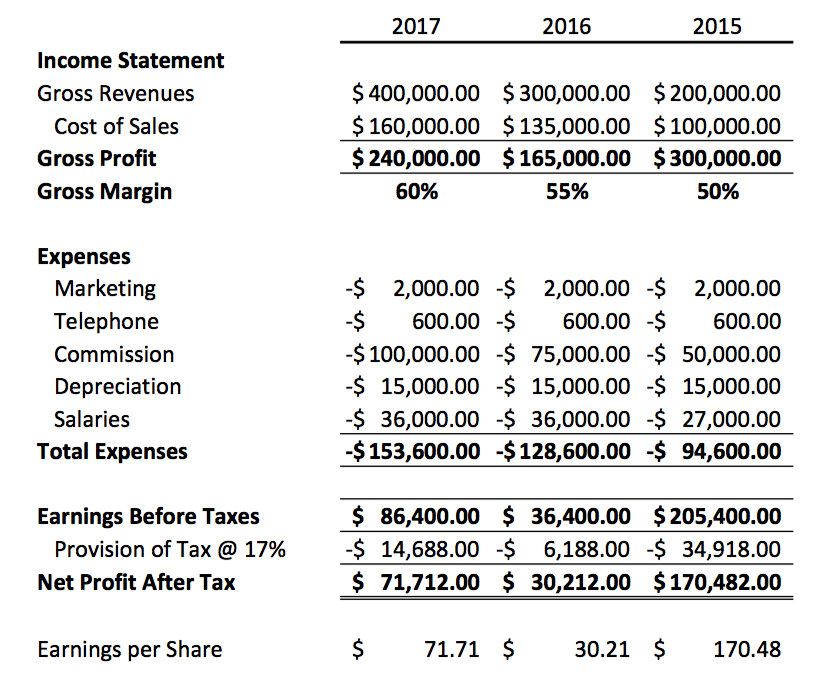
Now let us activate our most advanced technology of our imaginations, the time machine and travel into the future in December 31, 2017.
Screen Shot 2018-05-28 at 11.44.25 am

At a quick glance, we can see an improvement in gross margin from 50% to 60%. Also, we can see good growth due to marketing expenses staying constant despite its increase in gross profits. Alan starts taking a $3,000 per month salary starting from April 2015. Depreciation and telephone bills are constant as there are no increases in any form of telephone bills and there are no new generators purchased.

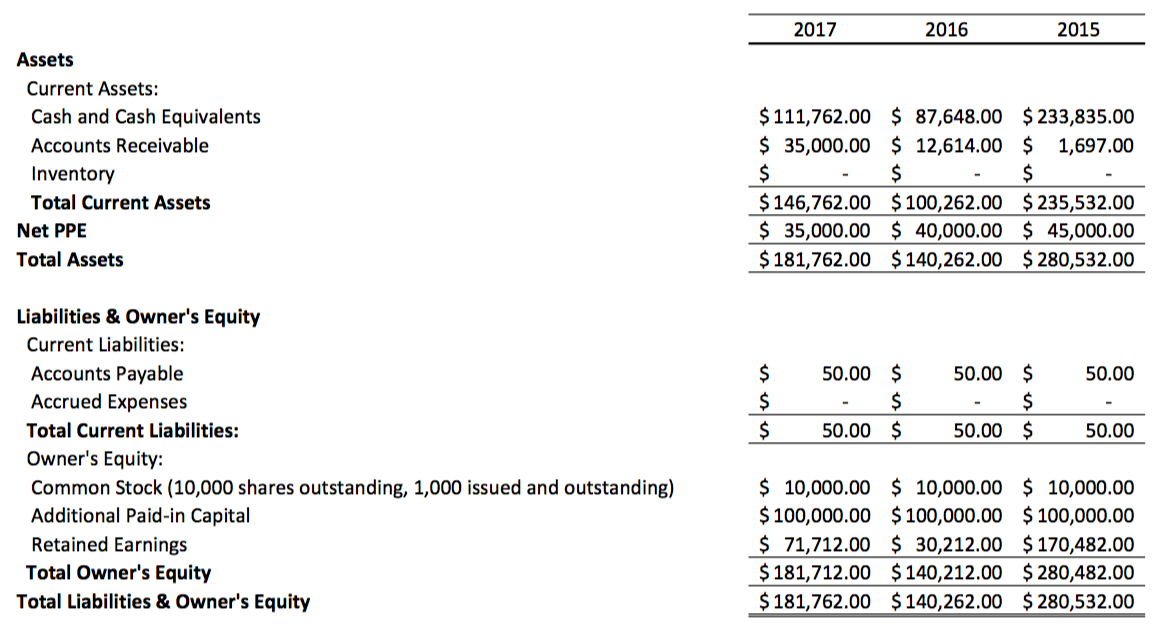
Let’s now take a look at the balance sheets:
Screen Shot 2018-05-28 at 12.12.44 pm.png

Each year, MSC has ended the year with more sales outstanding than the prior year, which is not a cause for joy or concern; it is what it is! We’ll see if it’s problematic in OE! PPE shows the ongoing depreciation of the generator as it becomes less and less valuable! On the liabilities side, we see that the company ends each year with $50 of Accounts Payable. That is the $50 December phone bill that is due on January 10th of the following year. Finally, we see that retained earnings has grown as the company continues to show profits each year.

Let’s move on to the cash flow statement.

Screen Shot 2018-05-28 at 12.26.52 pm

And now the whole story comes together. In this case, we can see that accounts receivables at the end of 2015 is $1,697 more than it is in the beginning of the year. The same reasoning goes for the other account receivables. Let’s now check out the differences between FCF and OE.

Screen Shot 2018-05-28 at 12.38.52 pm

The key difference between the two is that FCF does not take into account of any future spending the company might incur in the future. This is equivalent to treating it like a one-off event in the past. With OE, you are attempting to figure out how much cash would be left over for owners if  the business budgeted for future capital expenditures.

Some businesses do plan and budget very well, thus helping assure investors that capital expenditures will remain fairly constant year-on-year. Such is not the case with MSC! For example, we see that there is a need to plan for future capital expenditure in 2016, but this is not taken into account in 2015. Alan, you have so much more to learn!

After analyzing our example of MSC in the parallel universe, let’s analyze an actual company, General Motors (NYSE:GM). Here is their cash flow statement from 2005 to 2007.

Screen Shot 2018-05-28 at 12.44.35 pm

In the case of GM, we can see that the FCF and OE would yield drastically different results (all values stated in millions):

Screen Shot 2018-05-28 at 12.52.38 pm.png

The 2007 FCF shows that GM generated $189 million from operations, a turnaround from its FCF losses of $20 billion and $25 billion in 2006 and 2005, respectively. If investors are solely focused on FCF, he would probably think “Hmmm… The business might see the 2006 loss of $20 billion – $5 billion better than in 2005. This looks like a sign of improvement!”

When GM began generating positive FCF in 2007, the investor might mistakenly think that GM had fixed its problems, turned the corner, and was potentially poised for growth. So guess what, he screams “Hooray!” and goes into the stock market and buy the stock.

Now, hold on to your chairs… The OE paints a completely different picture altogether!

Starting with Net Loss from continuing operations (we need to see the performance of the ongoing business), we adjust for the various items, with capital expenditure being $71 billion for the previous 9 years (i.e. $7.8 billion per year or so). OE shows that everything is going downhill for GM from 2005 to 2007 (at an increasing rate for that matter). This difference can be explained from the non-cash charges that  GM deducted from earnings, but that were added back in when reconciling the cash flow statement. OE has the ability to see that FCF may not completely benefit owners.

Now, let’s take a look at the derivation to the final OE of GM. Over the long-term, the capital expenditure and depreciation should be equal. However, this isn’t the case when it comes to GM (which makes things much more complicated). This is because when a company is spending a lot more on capital expenditure than it is recording as depreciation, it is likely due to either:

  1. The company must make capital expenditures that exceed depreciation to maintain competitive, and/or
  2. The business is making capital expenditures above and beyond its requisite “regular maintenance” capital expenditures.

GM is having the exact opposite. Their depreciation and amortization greatly exceed capital expenditure. This is obviously an impossible situation since future capital expenditures have to be made to cause future depreciation! Either:

  1. GM is not spending enough to maintain its PPE, or
  2. This is a temporary state-of-affairs due to purchase of long-life assets (e.g. buildings) or because goodwill or other intangibles are amortized over extremely long periods (maybe 40 years? I don’t know).

In this case, we can’t assume this happy state of “taking bigger tax write-offs than we’re normally allowed” will continue forever, simply because we know that (reality check guys), over the long-term, capital expenditures and depreciation will provide a net sum of zero, and because we’re not worried about understating capital expenditures, we can assume that capital expenditures and depreciation are the same for GM under normal conditions. Any excess benefits will be written-off in the future capital expenditures.

So here’s the actual OE for GM:

Screen Shot 2018-05-28 at 1.16.03 pm

In this case, GM’s automotive business looks even grimmer than we originally thought! The company’s operations required nearly $11 billion of cash in 2005 and 2006. In 2007, the business was “hit by a missile”, making things even worse, requiring nearly $47 billion of excess cash just to keep the cars coming off the assembly line! The shortfall was covered by selling financial receivables, playing games with pension and OPEB, refinancing debt, and working some tax magic (very strong warlocks you have there by the way). As expected, the stock price goes down (price will follow value) as the business deteriorated (from $40 to $10):

Screen Shot 2018-05-28 at 1.21.04 pm

In summary, FCF is a good short-hand for scanning companies. When a company has minimal reconciliation to net income and steady and predictable capital expenditures, the difference between FCF and OE is close to none. In that case, either can be used for our valuation. Because of margin of safety, a minor difference between FCF and OE would be insignificant when calculating intrinsic value. Thus, most investors would use P/FCF as it is much more easily calculated.

OE, however, is still the best indicator of cash flow from the operating activities of the business, regardless of how management strives to juggle profitability and cash flow. When a company has a large amount of non-cash charges to GAAP earnings, OE is generally a more reliable indicator of business performance compared to FCF. In fact, depending on how creative, aggressive, or cautious management gets, FCF can be extremely skewed in these cases, as we saw with GM. It is noteworthy that, while FCF and OE can be substantially the same, they can also be substantially different.

Lesson learnt: Focus on Owner’s Earnings and use Free Cash Flow as a short-hand, easy to use tool, only if it makes sense.

This article is adapted from Joe Ponzio’s F Wall Street.
Understanding Annual Reports: Reading an Income Statement

Sometimes, investors get intimidated by large amounts of information presented on the annual report. However, as intimidating as they look, they provide useful information when evaluating companies. If you are someone who has an affinity for numbers (like myself), you would probably find yourself going for the financial statements.

This post would focus on the Income Statement, also known as the Profit-and-Loss (P&L) accounts. This details out everything that relates to how much the company is making or losing for the year. If a company is making money, this is shown as a positive value in the net income line. However, a P&L account is way more than that. Let’s take a look at an example of the P&L account of Biogen Inc. (NASDAQ:BIIB) in 2017, which was extracted from their annual report. I have annotated a couple of key items in the annual report.

BIIB 2017 IS annotated SniperInvestor

From this set of information, we can observe the following about Biogen:

  1. The revenue of their company mainly comes from their current products, with small portions coming in from other sources such as the anti-CD20 therapeutic programs. The revenue of the company has been rising over the 3-year-period.
  2. The cost of sales / cost of goods sold (COGS) has increased more than proportionately compared to their revenue, suggesting an erosion of bargaining power against suppliers.
  3. EBIT (Operating Income) has risen by approximately 8% from 2015 to 2017. This is likely due to the spike in the amortization of the intangible assets (likely patent expiry), the increase in R&D cost (likely to develop new patents), the collaboration profit sharing spike (which can’t be concluded much at this point), and the increase in COGS (as mentioned in 2).
  4. NPAT has fallen by about 33% from 2015 to 2017. This is likely due to the various factors impacting the low increase rate in EBIT, as well as the spike in income tax expenditure.

With these 4 points that are highlighted in purple in the income statement, let’s take a look at the noncontrolling interest (NCI) and the diluted earnings per share (dEPS).

NCI refers to is the portion of equity ownership in a subsidiary not attributable to the parent company, who has a controlling interest (greater than 50% but less than 100%) and consolidates the subsidiary’s financial results with its own.
Source: http://macabacus.com/accounting/noncontrolling-interest

So, imagine today Adam (representing Adam Ltd), Bala (representing Bala Pte Ltd) and Charlie (representing Charlie Pte Ltd) go into a joint venture known as ABC Pte Ltd. During the incorporation of ABC Pte Ltd, Adam Ltd owns 60% of ABC Pte Ltd, while Bala Pte Ltd and Charlie Pte Ltd each own 20% of ABC Pte Ltd. At the end of the financial year, ABC Pte Ltd has generated a total of US$10 million in revenue. However, as Adam Ltd is a listed company, it reports the earnings of ABC Pte Ltd in its P&L account. Now, to take into account of the 40% of ABC Pte Ltd she does not own, it would record an NCI of US$4 million, with NPAT due to ABC Pte Ltd attributable to Adam Pte Ltd being US$6 million. This is summarized below:

Non-Controlling Interest

Some of the key ratios that can be taken directly from the P&L account are:

  • dEPS = NPAT/Number of Shares at the End of the Financial Year
  • Gross Profit Margin (GPM) = (Revenue – COGS)/Revenue = Gross Profit/Revenue
  • Operating Profit Margin (OPM) = EBIT/Revenue
  • Net Profit Margin (NPM) = NPAT/Revenue
  • Operating Leverage = % change in EBIT/% change in Revenue

Try calculating these ratios of Biogen Inc. for yourself and see what conclusions you can draw out of them.

In conjunction with other financial statements, we can find out the following ratios:

  • Return on Equity (in conjunction with balance sheet)
  • Return on Asset (in conjunction with balance sheet)
  • Quality of Earnings (in conjunction with cash flow statement)

Try looking at the income statements of various companies and see what you can draw out of them:


May this bring you closer to your financial freedom. Snipers, Out!